Turbine wheel of cryogenic pump for liquid hydrogen (t=-170°) supply
extra strong granular metal
turbine wheel dia = 190 mm
total metal removal volume – 1900 mm3
total machining time – all blades on 2 sides = 12 days
Simultaneous 5 axes EDMing
Turbine wheel of cryogenic pump for liquid hydrogen supply
extra strong granular metal (115-120 kg/cm2)
space between turbine blades = 2,3 mm
turbine wheel dia = 190 mm
total metal removal volume – 3300 mm3
total machining time – 7 days (4 electrodes of 4 shapes for 4 blades on 2 sides)
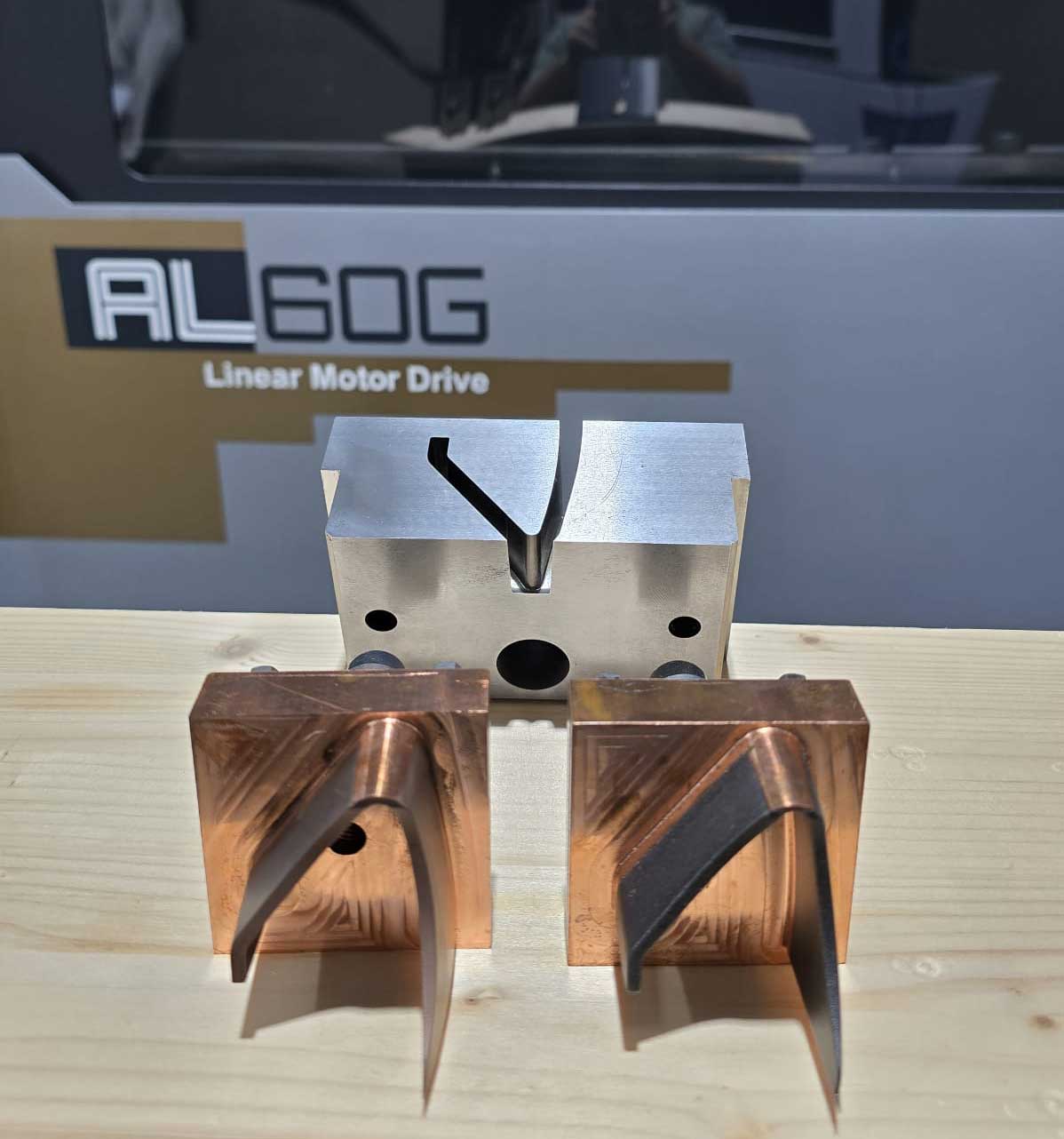
Deep cavity EDMing sample
Sodick AL60G Sinker EDM.
• Depth: 40 mm • Machining time: 10 hours • Copper electrodes: 2 pcs • Electrode area: 460 mm² each • Electrode offset (undersize): 0.6 mm • Surface finish: Ra 0.47 μm
Wall plug mold sinking:
2 electrodes, undersize 0.3 fine – 0.5 rough. LORAN – BAREL. Crosscut surface = 4800 mm2. Time=8 h 50 min for one machining. In the photo there are 4such machinings.
Smallest Corner R Machining
Stainless St – Cu, depth 0.3 mm
Surface Finish – Ra 0.12 µm
Bottom Corner R – 4 µm
SGF+ machining sample
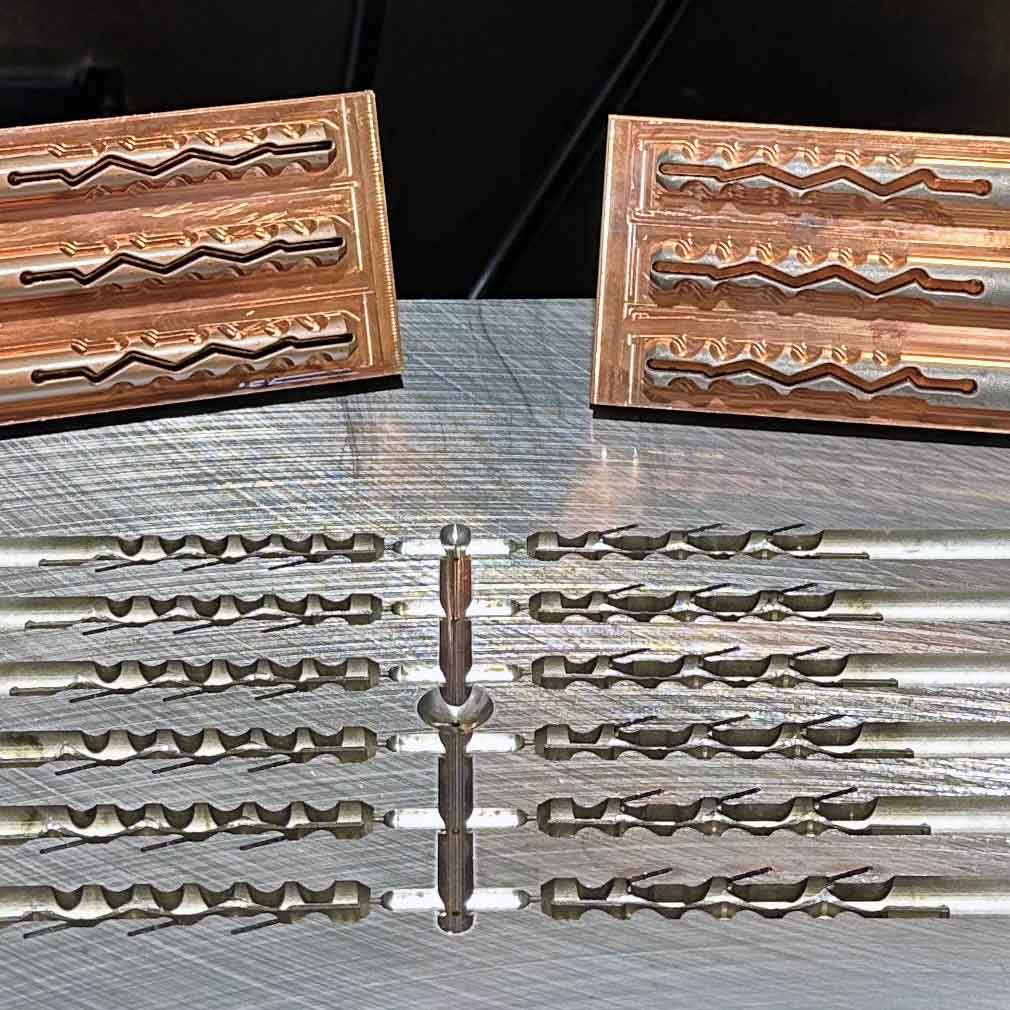
Multi-hole Machining by Intricate Electrode
Stainless steel – Cu electrode, depth 5 mm
Surface Finish – Ra 0.072 µm (Rz 0.41 µm)
Electrode Wear – finishing 0.002 mm (bottom)
Machining WC workpiece CuW electrodes using “TPC4”. Total Machining Time reduced by 28%
Steel EDMing sample
(XYZ & С 4-axes simultaneous control):
depth: 10 mm
roughness: Rz=2,6 µm / Ra=0,7 µm
machining time: 17 hr 10 min
electrode: copper
indexing angle: 20 °
Die-sinker EDM has become an indispensable manufacturing technology wherever conventional machining reaches its limits. Unlike milling or grinding, EDM produces complex three-dimensional cavities, deep narrow ribs, sharp internal corners, intricate micro-features and mirror-like surfaces without introducing cutting forces into the workpiece.
Today, Sodick Flat Linear Motor Die-Sinker EDM machines are used across virtually every high-precision industry. They manufacture moulds for plastic injection, pressure die casting, forging and powder metallurgy, while also machining stamping dies, extrusion tools and precision punches. In aerospace, they produce turbine blades, blisks, cooling channels and components made from difficult-to-machine superalloys. Medical manufacturers rely on EDM for surgical instruments, implants and miniature precision components. Electronics, semiconductor, optical and watch industries use it for micro-features measured in only a few microns.
Another important application is machining tungsten carbide, polycrystalline materials and other extremely hard conductive materials, where traditional cutting tools suffer from rapid wear. Advanced Sodick technologies such as SGF+ NANO, TPC4, Perfect Active Control and ultra-fast Flat Linear Motors provide exceptional machining stability, minimal electrode wear and outstanding surface quality even in the most demanding applications.
The ability of Flat Linear Motors to maintain an optimum spark gap with servo corrections up to 1,000 times per secondalso enables No-Flush EDM machining in many applications. By eliminating conventional flushing, manufacturers can reduce defects caused by unstable dielectric flow, improve dimensional accuracy and machine deeper, narrower cavities that would be difficult or impossible using conventional EDM technology.
From micron-scale precision components to large aerospace tooling, Sodick Die-Sinker EDM machines combine accuracy, productivity and long-term reliability, making them one of the world’s most advanced solutions for precision electrical discharge machining.
SGF+ machining sample
(Gr electrode NANOwear):
EDM sinking of a cavity in steel with a graphite electrode. The corners of the workpiece are well machined and there is no wear on the electrode. On the left is the same cavity before machining.
Tungsten carbide machining sample:
Electrodes: copper-tungsten х 3 Dimensions: Ø 5,24 mm, depth 15 mm Roughness: Ra 0,61 µm Undersize: 0,12 mm/side N0-flush Machining (the part is cut into 2 parts with a Wire-Cut EDM to show the surface quality).
Gr-St EDM machining sample:
An example of electric discharge sinking of a deep, narrow groove cavity without flushing the dielectric fluid (sludge removal due to the pumping effect of ultra-fast electrode movements)
This website uses cookies to improve your experience. We'll assume you're ok with this, but you can opt-out if you wish.AcceptRead More
Privacy & Cookies Policy
Privacy Overview
This website uses cookies to improve your experience while you navigate through the website. Out of these cookies, the cookies that are categorized as necessary are stored on your browser as they are essential for the working of basic functionalities of the website. We also use third-party cookies that help us analyze and understand how you use this website. These cookies will be stored in your browser only with your consent. You also have the option to opt-out of these cookies. But opting out of some of these cookies may have an effect on your browsing experience.
Necessary cookies are absolutely essential for the website to function properly. This category only includes cookies that ensures basic functionalities and security features of the website. These cookies do not store any personal information.
Any cookies that may not be particularly necessary for the website to function and is used specifically to collect user personal data via analytics, ads, other embedded contents are termed as non-necessary cookies. It is mandatory to procure user consent prior to running these cookies on your website.